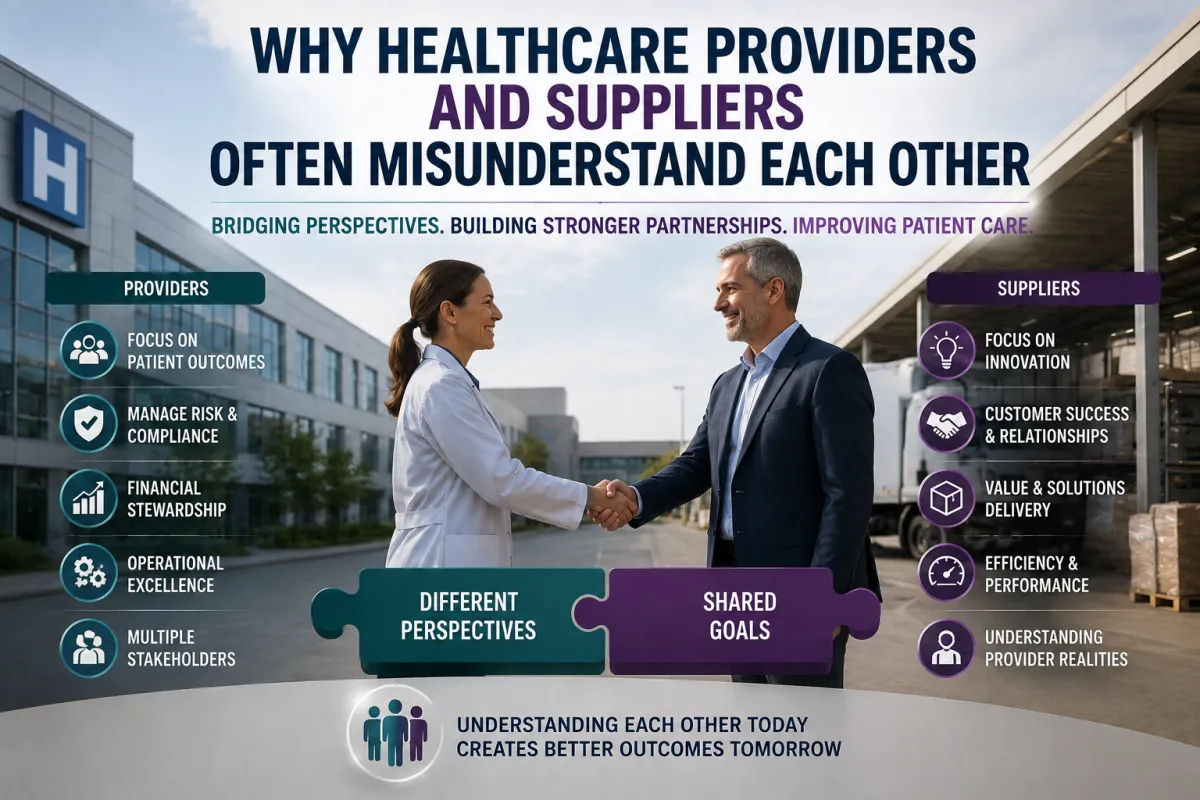
Bridge the Gap: Why Healthcare Providers and Suppliers Often Misunderstand Each Other
Healthcare providers and suppliers ultimately want the same thing.
Better patient care.
Yet despite working toward a common goal, these two groups often approach healthcare from very different perspectives. Those differences can create frustration, slow decision-making, and prevent organizations from building the strategic partnerships needed to improve healthcare.
In my experience working on both sides of the industry, one of the biggest challenges isn't a lack of good intentions.
It's a lack of understanding.
Providers and suppliers often speak different languages, measure success differently, and operate under very different realities.
The good news?
When both sides take the time to understand one another, relationships become stronger, decisions become better, and patient care benefits.
The Provider Perspective
Healthcare organizations make purchasing decisions in one of the most complex environments of any industry.
A product decision is rarely based on price alone.
Supply chain leaders must balance:
Clinical outcomes
Patient safety
Physician preferences
Nursing workflows
Financial stewardship
Contract compliance
Regulatory requirements
Operational efficiency
Standardization
Long-term organizational strategy
Before a product reaches a patient, it may be reviewed by clinicians, supply chain, finance, infection prevention, value analysis committees, executive leadership, and other stakeholders.
From the outside, this process can appear slow.
From the inside, it is necessary.
Healthcare organizations are not simply purchasing products.
They are making decisions that affect patient care, caregiver experience, organizational performance, and long-term financial sustainability.
The Supplier Perspective
Healthcare supply chain does not operate in isolation.
Every supply chain decision ultimately impacts clinicians and patients.
Organizations that consistently outperform their peers actively engage physicians, nurses, and clinical stakeholders throughout the decision-making process.
Successful clinical integration includes:
Collaborative product evaluations
Evidence-based decision-making
Shared accountability for outcomes
Transparent communication
Ongoing clinician engagement
When clinicians are treated as partners rather than customers, organizations create stronger alignment and more sustainable results.
The goal is not simply product standardization.
The goal is achieving the best clinical and financial outcomes together.
Suppliers operate under a different set of expectations.
They are responsible for bringing innovative products to market, supporting customers, meeting sales goals, and demonstrating the value of their solutions.
Most supplier professionals genuinely want to help healthcare organizations solve problems.
However, many have never been taught how hospitals actually make purchasing decisions.
As a result, suppliers often become frustrated when:
Decisions take months.
Multiple stakeholders become involved.
Clinical evaluations continue after product demonstrations.
Additional evidence is requested.
A physician's support does not immediately lead to approval.
These are not signs that healthcare organizations are resisting innovation.
They are signs that healthcare organizations are managing risk responsibly.
Where Misunderstandings Begin
The disconnect often starts because each side sees only part of the picture.
Providers may view suppliers as focused primarily on selling products.
Suppliers may view providers as unnecessarily slow or overly bureaucratic.
In reality, both perspectives are incomplete.
Providers are balancing competing priorities across the entire organization.
Suppliers are balancing innovation, customer expectations, and business growth.
Neither side succeeds without the other.
Building Better Partnerships
The strongest provider-supplier relationships are built on trust, transparency, and mutual respect.
Here are five ways both sides can strengthen collaboration:
1. Start with curiosity.
Ask questions before offering solutions. Understanding organizational priorities creates better conversations.
2. Focus on outcomes, not products.
Healthcare leaders are looking for partners who can improve clinical, operational, and financial performance, not simply introduce new technology.
3. Respect the decision-making process.
Healthcare decisions require input from multiple stakeholders because the impact extends far beyond a single department.
4. Communicate openly.
Sharing challenges, expectations, and timelines helps build stronger relationships and reduces unnecessary frustration.
5. Invest in education.
The more providers understand supplier challenges, and the more suppliers understand healthcare operations, the more productive every conversation becomes.
The Bridge Between Both Worlds
One of the greatest opportunities in healthcare today is not simply improving supply chains.
It is improving understanding.
When providers understand the realities suppliers face, collaboration becomes easier.
When suppliers understand how healthcare organizations evaluate products and make decisions, they become more valuable partners.
Better communication leads to better decisions.
Better decisions lead to better patient care.
And that benefits everyone.

Final Thoughts
Healthcare does not need stronger transactional relationships.
It needs stronger strategic partnerships.
The organizations and suppliers that invest in understanding one another will be better equipped to navigate change, solve complex challenges, and deliver greater value across the healthcare ecosystem.
Sometimes the most important bridge we can build is not between departments.
It is between perspectives.
Continue your Professional Journey
Every successful healthcare partnership begins with understanding.
Whether you're a healthcare provider looking to strengthen organizational performance or a supplier seeking to become a more strategic partner, continuous learning is one of the most valuable investments you can make.

Ready to Take the Next Step?
📚 Download Free Resources
Access practical tools, templates, guides, and insights designed to help healthcare supply chain professionals create greater impact within their organizations.
📧 Subscribe to The Hub Weekly
Receive practical healthcare supply chain insights, leadership strategies, industry trends, and new articles from The Bridge delivered directly to your inbox every Thursday.
🎓 Learn More About the Healthcare Supply Chain Foundations Certification
Build a deeper understanding of how healthcare organizations operate, how purchasing decisions are made, and how providers and suppliers can work together more effectively. The Foundations Certification is designed to give healthcare professionals and industry partners the knowledge needed to create stronger relationships and better outcomes.