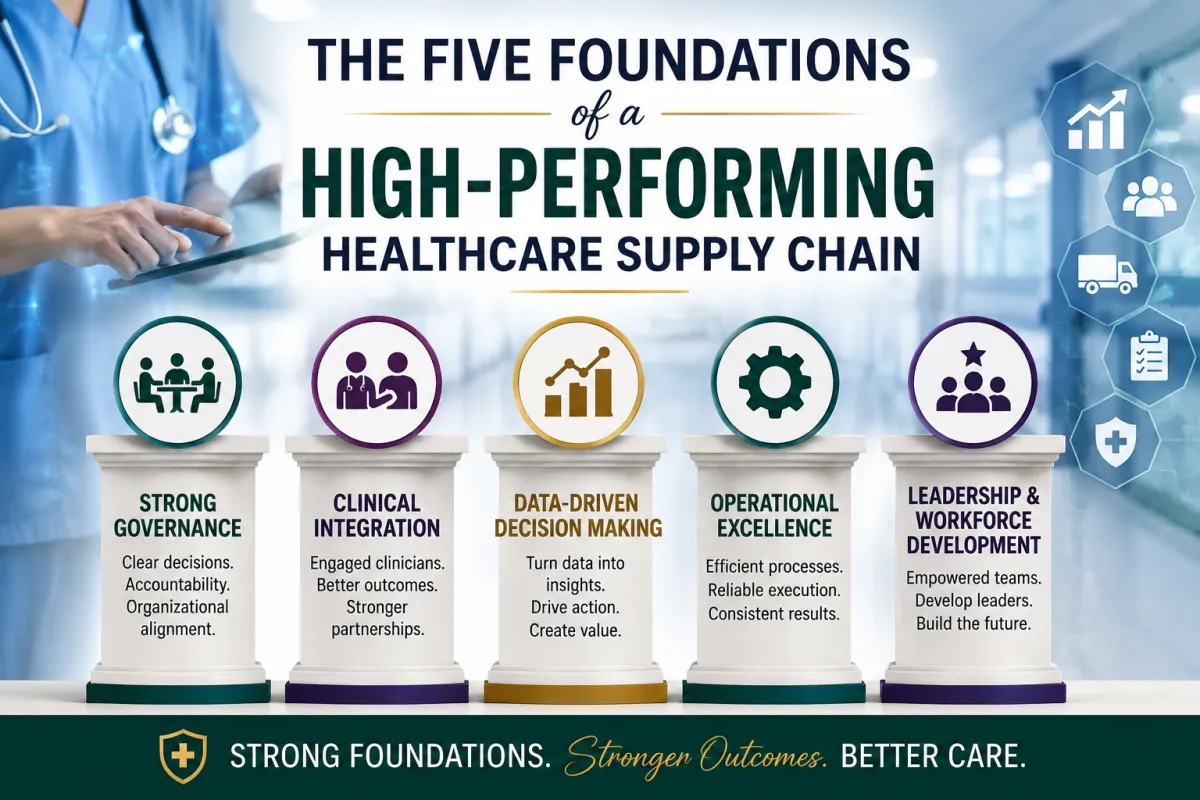
The Five Foundations of a High-Performing Healthcare Supply Chain
Healthcare supply chains have never been more important.
Organizations today face increasing pressure to reduce costs, improve patient outcomes, support clinicians, manage supply disruptions, and contribute to broader organizational goals. Yet while many healthcare systems invest heavily in technology, analytics, and process improvement initiatives, the highest-performing supply chains consistently share something more fundamental.
They have built a strong foundation.
High-performing healthcare supply chains are not created by chance. They are intentionally designed around core principles that enable long-term success, organizational alignment, and sustainable results.
While every organization is unique, the most successful healthcare supply chains consistently excel in five critical areas.
Foundation 1: Strong Governance and Decision-Making
Without governance, consistency becomes nearly impossible.
Organizations often struggle with product variation, competing priorities, inconsistent decision-making, and lack of accountability when clear governance structures are absent.
Strong governance establishes:
Clear decision-making authority
Defined approval processes
Accountability for outcomes
Alignment between departments
Standardized evaluation criteria
Governance creates the framework that allows organizations to make strategic decisions rather than reacting to individual requests or departmental preferences.
The strongest healthcare supply chains understand that governance is not about creating bureaucracy.
It is about creating alignment.
Foundation 2: Clinical Integration and Stakeholder Engagement
Healthcare supply chain does not operate in isolation.
Every supply chain decision ultimately impacts clinicians and patients.
Organizations that consistently outperform their peers actively engage physicians, nurses, and clinical stakeholders throughout the decision-making process.
Successful clinical integration includes:
Collaborative product evaluations
Evidence-based decision-making
Shared accountability for outcomes
Transparent communication
Ongoing clinician engagement
When clinicians are treated as partners rather than customers, organizations create stronger alignment and more sustainable results.
The goal is not simply product standardization.
The goal is achieving the best clinical and financial outcomes together.
Foundation 3: Data-Driven Decision Making
Data has become one of the most valuable assets in healthcare supply chain.
Yet having data and using data effectively are two very different things.
Many organizations generate reports.
Fewer organizations generate meaningful insights.
High-performing supply chains leverage data to:
Identify utilization variation
Monitor contract compliance
Evaluate supplier performance
Measure savings initiatives
Support executive decision-making
Improve operational efficiency
Data should help leaders answer critical questions, identify opportunities, and drive action.
When used effectively, data becomes a strategic advantage rather than simply a reporting tool.
Foundation 4: Operational Excellence
Operational excellence is the engine that powers healthcare supply chain performance.
No matter how strong governance, clinical engagement, or analytics may be, organizations must still execute consistently at the operational level.
Operational excellence includes:
Inventory management
Procurement efficiency
Distribution effectiveness
Demand planning
Process standardization
Supply continuity
The best organizations focus on building reliable, repeatable processes that reduce waste, improve service levels, and create capacity for strategic work.
Operational excellence is not about perfection.
It is about creating consistency and reliability across the organization.
Foundation 5: Leadership and Workforce Development
Technology can be purchased.
Processes can be redesigned.
Systems can be upgraded.
But sustainable success ultimately depends on people.
One of the most overlooked components of healthcare supply chain performance is leadership development.
Future supply chain leaders must possess skills that extend far beyond traditional operations.
They must understand:
Strategic planning
Change management
Financial management
Executive communication
Analytics
Clinical operations
Organizational influence
Organizations that invest in developing their people create stronger teams, stronger cultures, and stronger long-term results.
The future of healthcare supply chain will be shaped by leaders who can connect operational execution with organizational strategy.
Why These Foundations Matter
Many organizations focus on individual projects, technology implementations, or short-term initiatives.
While these efforts can generate value, they rarely create lasting transformation without a strong foundation.
Organizations that consistently achieve high levels of performance focus first on building the capabilities that support sustainable success.
They understand that governance, clinical integration, analytics, operational excellence, and leadership development are not separate initiatives.
They are interconnected elements of a mature healthcare supply chain.
When these foundations work together, organizations become more resilient, more efficient, and better positioned to support their mission.

Final Thoughts
High-performing healthcare supply chains are not defined by a single technology, process, or organizational structure.
They are defined by their ability to consistently create value across the organization.
Building that capability starts with a strong foundation.
Before pursuing the next technology platform, analytics tool, or transformation initiative, healthcare leaders should ask a simple question:
Are our foundations strong enough to support where we want to go?
Because long-term success is rarely determined by what an organization builds on top.
It is determined by what it builds upon.
Continue your Professional Journey
The ideas shared in this article are just the beginning.
High-performing healthcare supply chains are built intentionally. Strong governance, clinical integration, analytics, operational excellence, and leadership development do not happen by accident. They require focus, commitment, and a dedication to continuous improvement.
Whether you're looking for practical tools, weekly industry insights, or professional development opportunities, Healthcare Supply Chain Hub is here to help you continue building the knowledge and skills needed to make a greater impact across healthcare.
Ready to Take the Next Step?
📚 Download Free Resources
Access practical tools, templates, guides, and insights designed to help healthcare supply chain professionals create greater impact within their organizations.
📧 Subscribe to The Hub Weekly
Receive practical healthcare supply chain insights, leadership strategies, industry trends, and new articles from The Bridge delivered directly to your inbox every Thursday.
🎓Learn More About CHSCM
Explore the Certification in Healthcare Supply Chain Management (CHSCM) and develop the leadership, strategic sourcing, clinical integration, analytics, procurement, and operations skills needed to excel in today's healthcare environment.