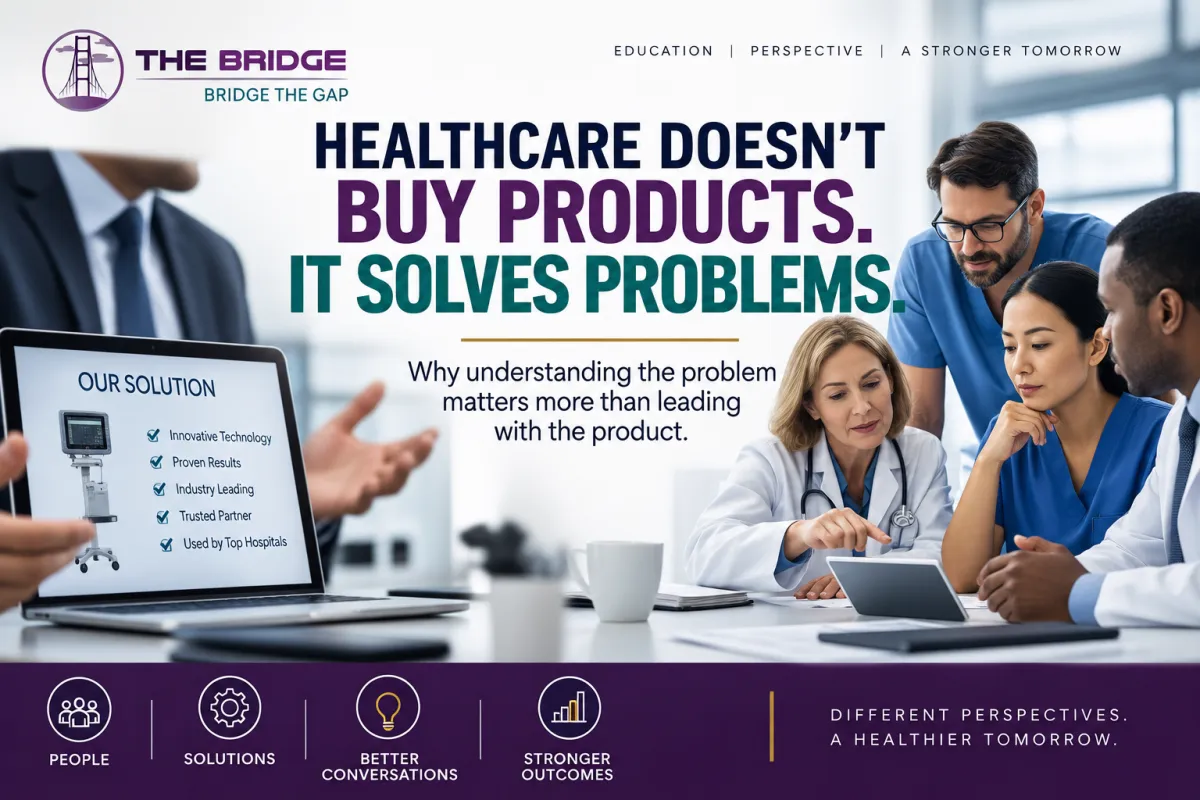
Healthcare Doesn't Buy Products. It Solves Problems. Why understanding the problem matters more than leading with the product.
I have sat through more supplier presentations than I could ever count. Most of them start the same way. There's a company slide, then a product slide, then the technology, the clinical evidence, the features that set it apart from the competition, and finally a list of the organizations already using it.
None of that is wrong, exactly. Providers need that information eventually. But I have noticed, sitting in meeting after meeting, that we often get quite far into the conversation before anyone actually explains the problem the solution is supposed to solve.
That gap, between what suppliers present and what providers are actually looking for, is where a lot of good pitches quietly fall apart.
Health systems are not shopping for products. They are managing thousands of them already, alongside hundreds of suppliers, dozens of contracts, aging technology platforms, capital requests, clinical initiatives, and cost pressures that never seem to ease. Adding something new doesn't feel like an opportunity so much as another commitment layered onto an already crowded plate. For a new solution to earn real attention, it has to attach itself to a problem that matters to the people in the room. And that changes where the conversation ought to begin.
The Product Is Only The Part Of The Story
It's understandable that suppliers lead with their products. Their teams have spent years building them: refining the technology, gathering evidence, learning exactly what makes their solution different from everyone else's. By the time they walk into a hospital boardroom, they know their product better than almost anyone.
But inside a health system, we're looking at the same moment from a completely different angle.
A supply chain leader might be wrestling with an underperforming contract, an unexpected shortage, too much product variation, or a capital constraint that won't budge. A clinical leader is thinking about outcomes, patient safety, staffing, workflow. Finance has its own math to solve. So do operations, IT, and the executive suite.
A supplier can walk in with a genuinely excellent product, and still, the first question in the room isn't whether it's good. It's whether it solves something we actually need solved. That distinction sounds obvious. In practice, it's the thing most easily overlooked.
A Good Idea Can Still Arrive At The Wrong Time
One of the harder truths about selling into healthcare is that a good idea does not automatically become a priority.
A solution can have compelling clinical evidence. The financial case can hold up. Physicians can be genuinely interested. The operational upside can be clear to everyone in the meeting. And the organization can still say no, or, more often, not yet.
That's not a reflection on the product. It's a reflection of capacity. Capital is limited. Implementation bandwidth is limited. Clinical teams can only absorb so much change at once, and supply chain, contracting, IT, finance, and operations are usually already stretched across several initiatives at the same time. Every new project draws down some of that shared capacity, whether or not anyone says so out loud.
So providers aren't only asking whether something has value. We're asking whether that value is large enough to outcompete everything else already demanding our attention. It's worth remembering that "not now" is rarely a rejection. More often, it just means some other problem has a stronger claim on the organization's resources today.
Discover Should Come Before The Pitch
Some of the best supplier conversations I've had didn't start with a presentation at all. They started with questions.
What are you struggling with right now? How are you managing it today? Where is the current process falling short? What have you already tried, and why didn't it work? Who's affected by this, and what would actually need to change for it to be worth disrupting?
Those questions change the shape of the conversation entirely, because they give the supplier context before anyone is asked to evaluate a solution. They also tend to surface something uncomfortable but useful: the problem a supplier believes they solve isn't always the problem the provider actually has.
A technology sold on efficiency can quietly create an integration headache that outweighs the benefit. A product pitched around savings can end up demanding more labor or more inventory space than anyone accounted for. A clinical innovation can improve one part of care while introducing variation somewhere else entirely.
The reverse happens too. A solution presented mainly for its clinical merits can turn out to solve an operational or workforce problem the supplier never even mentioned, one that matters more to the organization than the pitch ever did. You only find that out when there's room in the conversation for it to surface.
Value Is Bigger Than The Price
Cost will always matter in healthcare. Given the financial pressure most health systems are under, pretending otherwise would be naive.
But price and value are not the same thing. A cheaper product can create costs elsewhere down the line. A more expensive one can sometimes reduce labor, prevent complications, improve throughput, simplify inventory, cut waste, or make an already difficult clinical process a little easier to manage. Increasingly, providers have to weigh the full picture rather than fixating on the unit price alone: what changes clinically and operationally, what it takes to implement, whether it disrupts staffing or workflow, whether it creates new technology dependencies, and what happens to total cost once all of that is accounted for. Above all: what measurable improvement should we actually expect once it's in place?
That's a far more honest definition of value than the number on the invoice.
There's Value In Knowing When To Walk Away Too
One of the fastest ways to earn real credibility with a health system is to recognize, openly, when your solution isn't the right fit.
That might sound like bad sales advice. It isn't. Providers remember it.
If the problem isn't significant enough to justify the disruption of change, say so. If the organization clearly isn't ready, acknowledge it rather than pushing past it. If what you're offering doesn't actually address the real issue, there's little to gain by forcing the connection. Healthcare leaders' time is scarce, and a supplier who respects that, who's willing to have an honest conversation about fit even when it costs them the sale, starts to feel less like someone closing a transaction and more like someone capable of being a long-term partner.
There may be no immediate deal at the end of that conversation. There may be something more valuable instead: trust.
Providers Need To Get Better At Defining The Problem Too
This isn't only a supplier issue.
Health systems can be just as quick to leap toward a solution. Someone says, "we need a new system," or "we need to replace this product," and suddenly the organization is comparing vendors before anyone has agreed on what's actually wrong with the current state.
That habit causes problems later. When the need itself is poorly defined, suppliers get inconsistent information, stakeholders end up evaluating different things entirely, requirements creep, the project loses focus, and by the time implementation wraps up, it's genuinely hard to say whether anything improved at all.
Providers owe it to the process to do the upfront work, too: What are we actually trying to change, and why does it matter? What does the current state really look like? What outcome are we trying to reach, and how will we know if we got there? Answer those questions before the market gets involved, and the conversations that follow become dramatically more productive.
Better Partnership Start With A Shared Problem
The strongest provider-supplier relationships I've seen were never built around a product. They were built around a shared understanding of what needed to improve.
The provider brings knowledge of the organization: its patients, its clinicians, its operations, its financial realities, its strategic priorities. The supplier brings market knowledge, technical expertise, and a vantage point shaped by everything they've seen work, and fail, at other organizations. Both sides bring something real to the table. The opportunity is to bring those perspectives together before either side becomes too attached to a particular answer.
That means suppliers have to spend less time assuming they already know the problem simply because they know their product well. And it means providers have to be more candid about what they're actually trying to accomplish. When both sides manage that, the conversation stops being about selling and buying, and starts being about solving.

Final Thoughts
Healthcare will always need innovative products, technology, and supplier partners. But innovation on its own doesn't determine whether an organization should make a change. That determination starts with defining, honestly, what needs to improve. For suppliers, that means learning enough about a customer's world to know whether the solution genuinely fits. For providers, it means resisting the urge to shop for an answer before the problem has been clearly defined.
Get that part right, and everything downstream gets better: the evaluation, the business case, the implementation, the measurement of value, and, eventually, the partnership itself.
So maybe the best opening line in a healthcare sales conversation isn't "can I show you what we do?"
It's simpler than that: Tell me what you're trying to solve.
That's a conversation worth having.
Continue your Professional Journey
Healthcare supply chain is much more than products, contracts, and transactions. Strong decisions require an appreciation for how clinical, operational, financial, and supply chain priorities intersect across an organization.
Whether you work inside a health system or support one as an industry partner, that foundational knowledge helps you ask better questions, evaluate value more thoughtfully, and build stronger partnerships.

Ready to Take the Next Step?
📚 Download Free Resources
Explore practical tools, guides, templates, and educational resources created for healthcare supply chain professionals and industry partners.
📧 Subscribe to The Hub Weekly
Stay connected with new articles exploring healthcare supply chain, leadership, provider-supplier relationships, and the issues shaping our profession.
🎓 Learn More About the Healthcare Supply Chain Foundations Certification
Develop a stronger understanding of how healthcare organizations operate and how clinical, financial, operational, and supply chain priorities influence the choices they make.