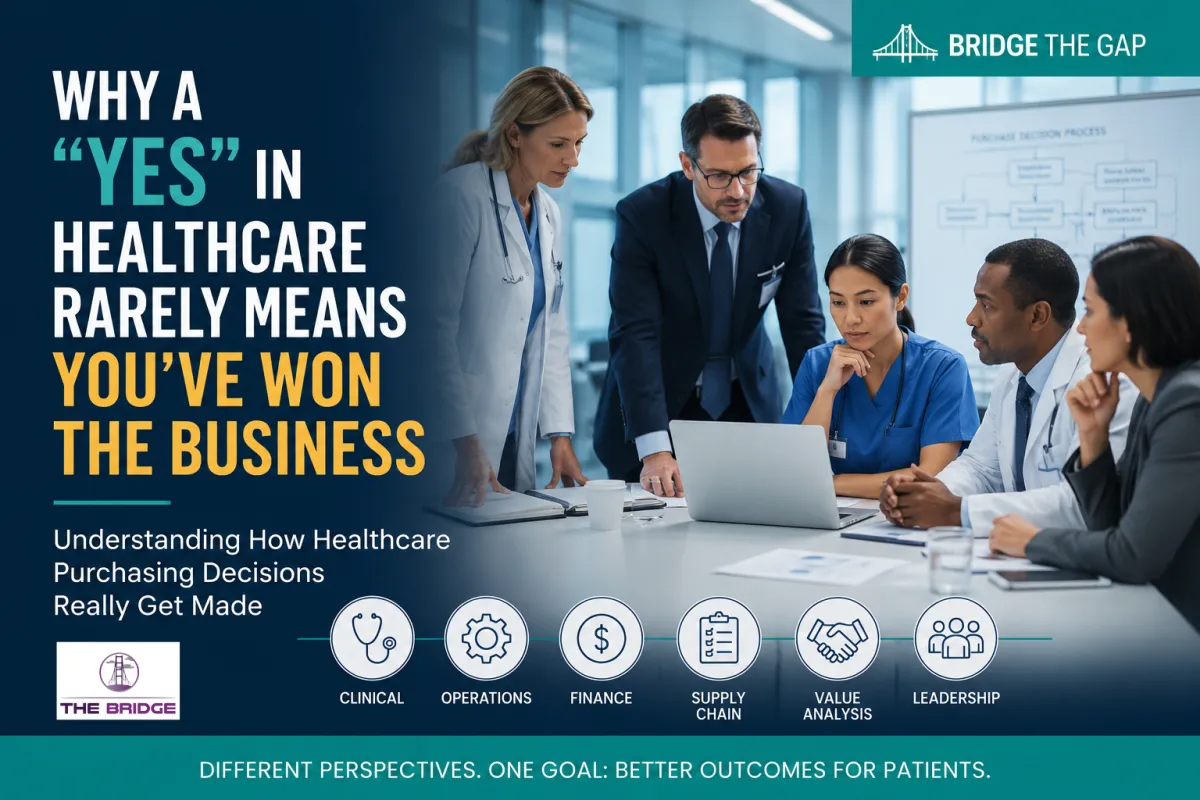
Why a “Yes” in Healthcare Rarely Means You’ve Won the Business

You had the meeting.
The clinician loved the product.
The department leader said, “This would really help us.”
The conversation went well. There was enthusiasm. Maybe someone even asked about next steps.
Everyone left smiling.
And somewhere on the drive home, someone on the supplier side thought:
We got it.
Not necessarily.
One of the hardest things to understand about healthcare is that a “yes” from an individual stakeholder is rarely the same thing as a “yes” from the organization.
That isn't because hospitals are intentionally making purchasing complicated.
It is because healthcare decisions are complicated.
Understanding that difference can completely change how suppliers approach healthcare organizations and how providers communicate with their industry partners.
The Healthcare “Decision-Maker” Is Rarely One Person
One of the first questions suppliers often ask is:
Who is the decision-maker?
It's a reasonable question.
It's also frequently the wrong question.
In healthcare, there may not be one decision-maker.
Depending on the product or service being evaluated, a decision could involve:
Physicians and other clinicians
Nursing leadership
Supply chain
Procurement
Strategic sourcing and contracting
Value analysis
Finance
Information technology
Infection prevention
Biomedical or clinical engineering
Operations
Executive leadership
Each stakeholder may evaluate the same solution through a completely different lens.
A physician might ask:
Will this improve clinical outcomes?
A nurse might ask:
How will this affect workflow?
Supply chain might ask:
Can we reliably source, distribute, and support it?
Finance might ask:
What is the total financial impact?
IT might ask:
Does it integrate with our existing technology?
Value analysis might ask:
What does the evidence tell us, and what problem are we actually trying to solve?
Those aren't competing questions.
Together, they help the organization understand the full impact of a decision.
Clinical Support Matters. But It Isn't Organizational Approval.
This is where misunderstandings can begin.
A clinician may genuinely love your product.
That's important.
Clinical engagement can be critical to evaluating new technology and understanding whether a solution could improve patient care.
But clinical support is usually one part of a much larger decision.
A hospital may still need to understand:
Whether a current contract already exists
Whether an equivalent product is already standardized
How the solution affects workflow
Whether implementation requires new equipment or technology
Whether additional training is required
What the total cost of ownership looks like
Whether there are supply continuity concerns
How the product fits organizational priorities
Whether the evidence supports the proposed value
This is why a positive clinical conversation doesn't always result in a purchase order.
The clinician wasn't necessarily misleading the supplier.
They may simply represent one voice in a much larger decision process.
A GPO Contract Isn't a Purchase Order Either
Another common misunderstanding occurs when a supplier earns a contract through a group purchasing organization.
That's an important accomplishment.
But access to a contract does not automatically mean every participating health system will purchase the product.
Individual healthcare organizations may still have existing agreements, standardization strategies, clinical preferences, implementation requirements, financial priorities, or internal approval processes.
Think of a contract as creating an opportunity to compete.
It doesn't eliminate the need to understand the customer.
The strongest suppliers don't stop at:
“We're on contract.”
They ask:
“What does this organization need, and where does our solution fit?”
That is a very different conversation.
Healthcare Organizations Are Evaluating More Than the Product
Suppliers understandably spend a great deal of time learning their products.
Features.
Clinical evidence.
Pricing.
Technology.
Competitive differentiation.
All of that matters.
But providers are evaluating something larger:
What happens to our organization if we say yes?
What changes for clinicians?
What changes for supply chain?
What changes for inventory?
What changes for IT?
What changes financially?
What training will be required?
What risk are we introducing?
What problem are we solving?
And perhaps most importantly:
Is solving this problem a priority right now?
A product can be excellent and still not be the right organizational decision at that moment.
That distinction matters.
The Better Question Suppliers Can Ask
Instead of asking:
“Who is the decision-maker?”
Try asking:
“Who needs to be involved in evaluating a decision like this?”
That one change opens a completely different conversation.
It signals that you understand healthcare decisions are collaborative.
It gives your provider partner an opportunity to explain the process.
And it helps you identify stakeholders earlier rather than discovering them six months into an evaluation.
Other valuable questions include:
What problem is the organization trying to solve?
How would a solution like this typically be evaluated?
What clinical, operational, and financial outcomes matter most?
Who else should we involve in the conversation?
What could prevent this initiative from moving forward?
Those questions move the conversation away from selling and toward understanding.
And that is where strategic partnerships begin.
Providers Have a Responsibility Too
Bridging the gap cannot be the supplier's responsibility alone.
Healthcare organizations can do a better job explaining how decisions are made.
If a supplier believes an individual stakeholder has purchasing authority when they don't, providers should clarify that early.
If an evaluation requires value analysis, contracting, IT review, executive approval, or other steps, communicating those expectations upfront helps everyone.
And when priorities change, providers should say so.
Suppliers invest people, resources, clinical expertise, samples, technology, and time into healthcare evaluations.
Transparency matters on both sides.
Strategic partnerships require mutual accountability.
From Selling a Product to Understanding Healthcare
The suppliers who become truly valuable partners learn to recognize that healthcare isn't a traditional sales environment.
They understand the ecosystem.
They understand that procurement is not simply there to negotiate price.
They understand why value analysis exists.
They understand why clinicians need a voice.
They understand why contracting matters.
They understand that operational impact can be just as important as clinical innovation.
And they understand that sometimes the answer is:
“This is a great solution, but not right now.”
That isn't necessarily rejection.
Sometimes it's prioritization.
Understanding the difference is part of understanding healthcare.
Final Thoughts
A “yes” in healthcare can mean many things.
“Yes, I'm interested.”
“Yes, I see the clinical value.”
“Yes, we should evaluate this.”
“Yes, let's bring in supply chain.”
None of those necessarily means:
“Yes, we're buying it.”
The strongest provider-supplier partnerships develop when both sides understand that distinction.
Suppliers become better partners when they understand how healthcare organizations make decisions.
Providers become better partners when they communicate those decision processes clearly.
Because ultimately, the goal shouldn't simply be getting to yes.
It should be getting to the right decision for the organization, the clinicians, and most importantly, the patients they serve.
Continue your Professional Journey
Understanding how healthcare organizations make decisions is foundational knowledge, whether you work inside a health system or support healthcare organizations as an industry partner.
The more we understand the people, processes, priorities, and perspectives behind those decisions, the better equipped we are to collaborate effectively and create meaningful value across healthcare.

Ready to Take the Next Step?
📚 Download Free Resources
Access practical healthcare supply chain tools, guides, templates, and educational resources designed to turn knowledge into action.
📧 Subscribe to The Hub Weekly
Stay connected with practical healthcare supply chain insights, leadership perspectives, industry education, and the latest articles from The Bridge.
🎓 Learn More About the Healthcare Supply Chain Foundations Certification
Build a stronger understanding of how healthcare supply chain really works. Healthcare Supply Chain Foundations introduces the essential concepts, terminology, stakeholders, processes, and perspectives that healthcare professionals and industry partners need to navigate the healthcare environment more effectively.