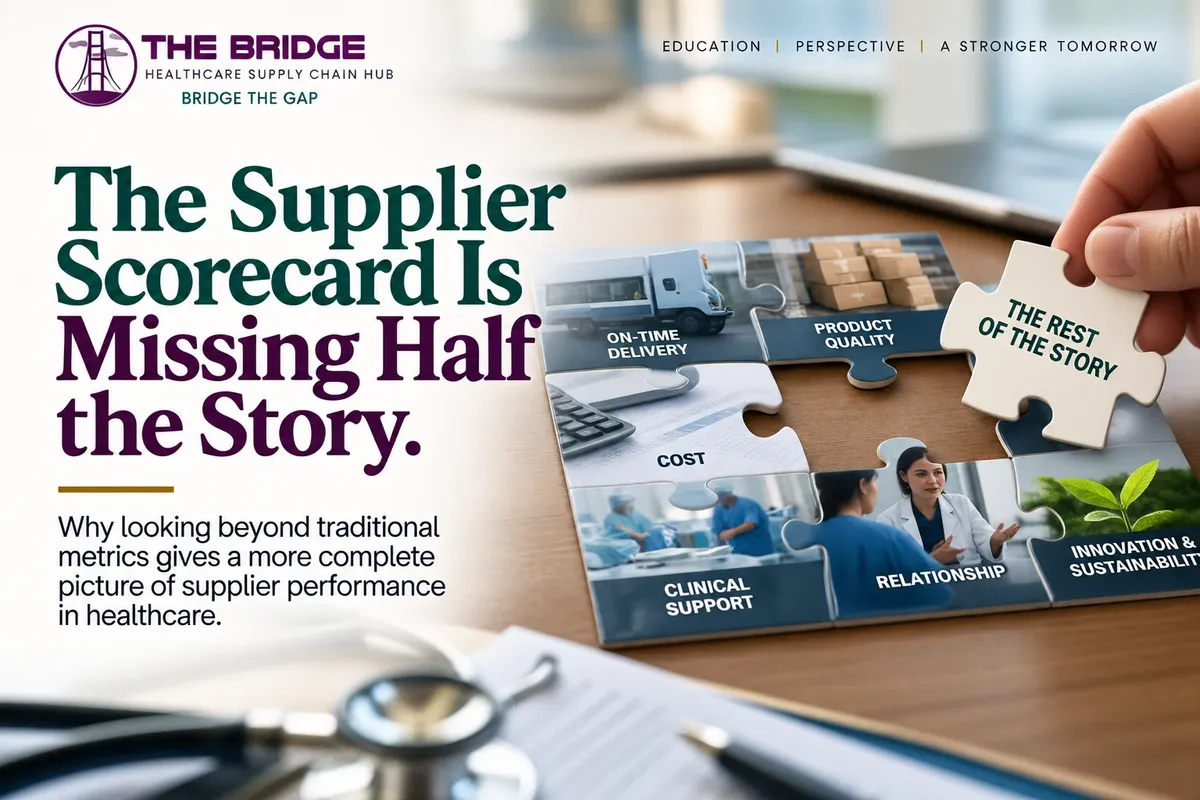
The Supplier Scorecard Is Missing Half the Story
Why price, fill rate, and on-time delivery cannot tell you whether a healthcare supplier is truly performing
Supplier scorecards make sense. Healthcare organizations need objective ways to understand performance, compare expectations with results, and hold important partners accountable.
So we measure what we can.
Price. Fill rate. On-time delivery. Backorders. Service levels. Contract compliance. Maybe response time or quality events.
Those measures matter. I would not remove them.
But anyone who has managed supplier relationships long enough knows that a supplier can look perfectly acceptable on a dashboard and still be one of the hardest relationships your organization manages.
The opposite can also be true. A supplier can have a temporary service problem and still prove itself to be an exceptional partner by the way it communicates, recovers, and prevents the issue from happening again.
The scorecard is useful. It just may not be telling the whole story.
The Metrics We Can Count Are Not Always the Metrics That Matter Most
Traditional supplier metrics tend to focus on transactions because transactions produce clean data. The order was filled or it was not. The shipment arrived on time or it did not. The invoice matched or it did not.
Healthcare experiences supplier performance more broadly.
A product can arrive on time while the implementation support is poor. A supplier can meet a fill-rate target while repeatedly shorting the items that matter most. Pricing can be correct at the contract level while item-level errors create months of invoice exceptions. A service team can technically meet its response standard while failing to resolve the underlying problem.
The metric may be accurate and still fail to describe the experience.
A 98 Percent Fill Rate Can Still Hurt
Aggregate performance can hide operational pain.
If a supplier fills 98 percent of orders, that may look excellent. But what sits inside the missing 2 percent? Routine products with easy substitutes? Or a critical item that forces clinical teams and supply chain staff into daily shortage management?
The same applies to delivery performance. Ninety-eight percent on-time delivery sounds strong until the late shipments repeatedly affect a facility with limited storage, a procedure schedule, or a product with no practical alternative.
Performance should be interpreted in context. Criticality, frequency, duration, and the operational consequence of failure matter alongside the percentage.
What Happens After Something Goes Wrong Matters
No supplier operates without problems. Manufacturing disruptions happen. Transportation fails. Demand changes unexpectedly. Technology breaks. People make mistakes.
The more revealing question is often what the supplier does next.
Do they communicate before the provider discovers the problem? Do they provide accurate information or optimistic estimates that repeatedly move? Do they bring alternatives? Do they coordinate internally, or does the health system have to chase multiple departments? Do they stay engaged until the issue is resolved?
Recovery behavior tells you a great deal about a supplier relationship.
A partner who communicates early and solves problems with you may create less risk than a supplier with slightly better routine metrics but poor escalation when something important fails.
Data Quality Is Supplier Performance
Healthcare supply chain increasingly depends on clean, timely information. Item numbers, units of measure, pricing, contract identifiers, substitutions, product changes, discontinuations, recalls, shipping information, and electronic transaction data all affect operations.
Bad data creates work.
It creates purchase-order exceptions, invoice discrepancies, manual research, delayed payments, receiving issues, incorrect pricing, and confusion for end users.
Yet data quality is not always treated as a supplier performance measure.
It should be.
A supplier that consistently provides accurate data and communicates changes early reduces friction across the entire procure-to-pay process. That value may never appear in a traditional service-level report, but the people doing the work feel it every day.
Implementation Support Belongs on the Scorecard
Many supplier relationships are won on the strength of the solution and then judged by what happens during implementation.
Was the supplier prepared? Were the right resources available? Was training effective? Were issues resolved quickly? Did the supplier understand the provider's workflow? Did commitments made during the sales process survive the handoff to the implementation team?
Those questions matter because a difficult implementation can consume a large amount of internal capacity and damage confidence in an otherwise good product.
For strategic suppliers, implementation performance should become part of the relationship history, not disappear once go-live is complete.
The Hidden Metric: How Much Work Does This Relationship Create?
This may be the least formal and one of the most useful questions a health system can ask.
How much work does this supplier create for us?
Not productive work such as joint planning, innovation, or meaningful problem-solving. I mean avoidable work: repeated invoice corrections, constant expediting, unresolved backorders, manual pricing research, duplicate emails, preventable substitutions, missing data, recurring escalations, and the same issue being explained to a new person every few months.
That labor has a cost even when it is spread across departments and never charged back to the supplier.
A relationship that requires constant organizational rescue may be more expensive than its contract suggests.

Build the Scorecard Around the Relationship You Need
Not every supplier needs a sophisticated scorecard. The effort should match the strategic importance, risk, spend, clinical impact, and complexity of the relationship.
For important suppliers, however, the scorecard should reflect more than transactions. It might include operational performance, issue resolution, data quality, implementation support, communication, resiliency, innovation commitments, and value realization.
Some measures will be quantitative. Others may require structured qualitative feedback.
That is okay.
The goal is not to create a perfect mathematical score. It is to create a useful conversation about whether the relationship is delivering what the organization needs.
Final Thoughts
Healthcare supply chain should absolutely measure supplier performance.
But we should be careful not to confuse what is easy to measure with everything that matters.
Price matters. Fill rate matters. Delivery matters.
So do transparency, recovery, data quality, implementation support, responsiveness, and the amount of work a relationship creates for the people managing it.
The best supplier scorecard is not the one with the most metrics.
It is the one that helps both sides see the relationship clearly enough to improve it.
Continue the Conversation
Healthcare supply chain is rarely about one transaction, one department, or one decision. The strongest organizations understand how the pieces connect and how decisions move from strategy into everyday operations.
Ready to Take the Next Step?
Healthcare Supply Chain Foundations is designed for provider and supplier professionals who want a stronger understanding of the people, processes, priorities, and decisions that shape healthcare supply chain.
📚 Download Free Resources
Explore practical tools and educational resources created for healthcare supply chain professionals and industry partners.
📧 Subscribe to The Hub Weekly
Get new articles and perspectives on the issues shaping healthcare supply chain and provider-supplier relationships.
🎓 Learn More About the Healthcare Supply Chain Foundations Certification
Build a stronger understanding of the people, processes, terminology, and decisions that shape how healthcare supply chain actually works.