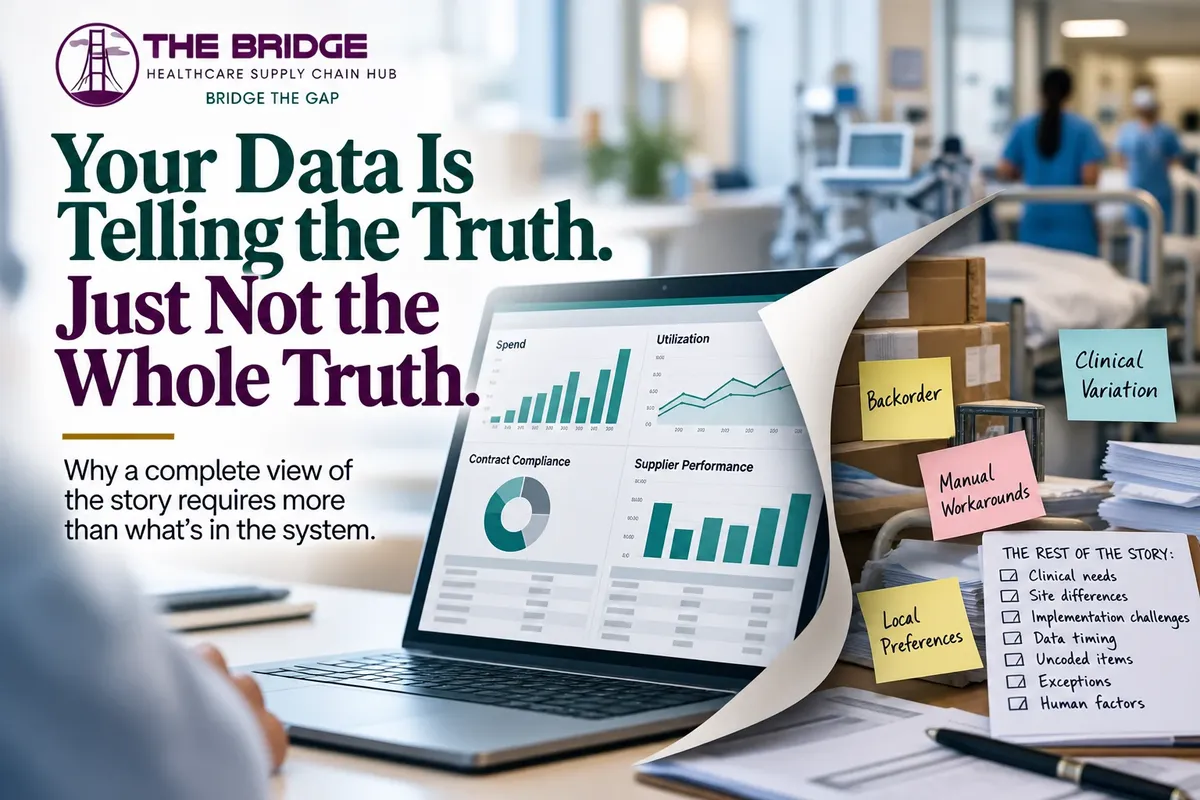
Your Data Is Telling the Truth. Just Not the Whole Truth.
Why spend and utilization data can show what healthcare bought without explaining the value it created
Healthcare supply chain has become much better at seeing its own data.
We can analyze spend by supplier, category, facility, department, and item. We can track utilization. We can identify price variation, contract leakage, purchase patterns, and opportunities for standardization. In many organizations, we can get to a level of detail that would have been difficult to imagine years ago.
That visibility has changed the profession for the better.
But there is a point where traditional supply chain data reaches its limit.
It can tell us what we bought. It can tell us what we paid. It can often tell us where and how frequently a product was used.
What it usually cannot tell us by itself is whether that choice created better value for the patient or the organization.
That is not a failure of supply chain data. It is a reminder that value lives across multiple data sets.
Spend Data Answers an Important Question
Spend is foundational. Before an organization can manage a category, it needs to know where the money is going. Without reliable spend data, even basic sourcing becomes difficult.
Utilization adds another layer. It helps us understand volume, variation, trends, and behavior. Together, spend and utilization can reveal meaningful opportunities.
But those data answer a particular set of questions.
What did we buy? From whom? At what price? How much did we use? Where did we use it?
Those are not the same as asking whether the product reduced complications, improved throughput, shortened a procedure, reduced labor, lowered waste, or supported a better patient outcome.
Utilization Shows What Happened, Not Why
Suppose one hospital uses substantially more of a product than another. The data can show the variation clearly.
It cannot automatically explain the reason.
Maybe the patient populations are different. Maybe physician practice patterns differ. Maybe one site performs a different mix of procedures. Maybe the product is being wasted. Maybe the documentation is inconsistent. Maybe one hospital has standardized while another has not.
The utilization signal is valuable because it tells us where to look.
The mistake is treating the signal as the conclusion.
The Missing Connection Is Often Outside Supply Chain
Some of the information supply chain needs most sits elsewhere in the organization.
Clinical outcomes may live in the electronic health record or a clinical registry. Procedure time may be captured in perioperative systems. Labor information may sit in workforce systems. Revenue and reimbursement live in financial platforms. Quality events may be managed in another application entirely.
That fragmentation makes total-value analysis difficult.
It also explains why supply chain teams can find themselves negotiating aggressively on unit price while lacking visibility into the downstream economic or clinical consequences of product choice.
We may know the acquisition cost to the penny and still be estimating the total cost.
Total Cost of Ownership Requires a Broader Lens
Total cost of ownership is often discussed as though it is simply purchase price plus a few additional expenses.
In healthcare, it can be much broader.
A product may affect procedure time, length of stay, waste, reprocessing, inventory requirements, capital equipment, maintenance, training, complications, readmissions, labor, throughput, or reimbursement.
Not every category requires that level of analysis. We do not need a clinical outcomes study to buy office supplies.
But for high-cost, high-risk, clinically significant, or workflow-intensive categories, acquisition price alone may be a poor proxy for value.
Connecting the Data Is an Organizational Challenge
It is tempting to describe this as a technology problem. Sometimes it is.
But even when the data technically exist, organizations still have to agree on definitions, ownership, access, methodology, and what constitutes credible evidence.
Finance may calculate value differently from supply chain. Clinical leaders may want risk adjustment. Operations may care about labor and throughput. Suppliers may bring evidence from other organizations that does not perfectly match local practice.
Connecting data therefore requires governance as much as analytics.
The question is not simply, 'Can we get the data?' It is also, 'Can we agree on what the data mean for this decision?'
Suppliers Should Understand the Evidence Gap
Suppliers often have access to clinical studies, product evidence, implementation experience, and economic models that can help providers think more broadly about value.
That information can be useful, but it needs to be presented with appropriate context.
A model built on assumptions from another health system is not the same as a locally validated result. A clinical endpoint may not translate directly into financial savings. A time reduction matters economically only if the organization can use the recovered capacity or reduce a real cost.
The strongest supplier conversations distinguish evidence from assumption and help the provider identify what would need to be validated locally.

Start With the Decision, Not the Dashboard
More data are not automatically better.
Before building another dashboard, it helps to ask what decision the organization is trying to improve.
Are we deciding between two technologies? Trying to understand physician variation? Evaluating whether a standardization effort delivered value? Looking for capacity? Measuring a supplier commitment?
Once the decision is clear, the data requirements become clearer too.
That approach also prevents teams from spending months connecting data simply because the data are available.
Final Thoughts
Supply chain data tells the truth.
It tells us what we bought, what we paid, where variation exists, and where opportunities may be hiding.
But the truth it tells is only one part of the healthcare story.
If supply chain wants to move further into value-based decision-making, we need stronger connections to the clinical, operational, and financial information that explains what happened after the purchase.
That does not diminish the importance of spend and utilization data.
It makes those data more powerful.
Because the goal is not simply to know what healthcare bought.
It is to understand what the organization received in return.
Continue the Conversation
Healthcare supply chain is rarely about one transaction, one department, or one decision. The strongest organizations understand how the pieces connect and how decisions move from strategy into everyday operations.
Ready to Take the Next Step?
Healthcare Supply Chain Foundations is designed for provider and supplier professionals who want a stronger understanding of the people, processes, priorities, and decisions that shape healthcare supply chain.
📚 Download Free Resources
Explore practical tools and educational resources created for healthcare supply chain professionals and industry partners.
📧 Subscribe to The Hub Weekly
Get new articles and perspectives on the issues shaping healthcare supply chain and provider-supplier relationships.
🎓 Learn More About the Healthcare Supply Chain Foundations Certification
Build a stronger understanding of the people, processes, terminology, and decisions that shape how healthcare supply chain actually works.