
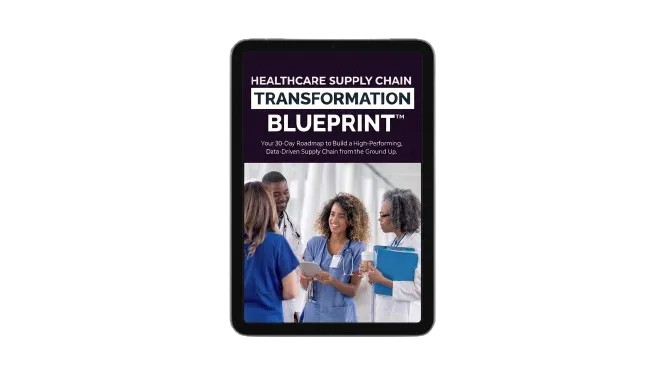
TRANSFORM YOUR HEALTHCARE SUPPLY CHAIN
Stop Fixing Symptoms. Start Transforming the System.
Healthcare Supply Chain Transformation Blueprint™
A practical assessment and action framework designed to help healthcare leaders identify structural gaps, clarify priorities, and build a stronger foundation for sustainable supply chain transformation.
Evaluate your organization across the Eight Transformation Pillars™ before investing more time, money, technology, or leadership credibility into the wrong problem.
Transformation Stalls When the Real Problem Is Still Hidden
Healthcare supply chain teams can be incredibly busy and still struggle to move the organization forward.
A contracting problem may actually be a governance problem. An inventory problem may be a data problem. A technology problem may be a process problem. A compliance problem may be an accountability problem. When the root cause is unclear, organizations can spend months adding meetings, dashboards, systems, initiatives, and resources while the underlying operating model remains unstable.
The Healthcare Supply Chain Transformation Blueprint™ helps leaders step out of the day-to-day noise and evaluate the infrastructure supporting the work.
See the Whole System Before You Decide What to Fix
The Transformation Blueprint™ gives healthcare leaders a structured way to assess the current state of their supply chain, identify gaps, prioritize opportunities, assign ownership, and begin building a practical roadmap for improvement.
It is designed to help you:
Separate symptoms from root causes
Evaluate organizational maturity across the full healthcare supply chainBullet List 3
Identify gaps in structure, governance, process, people, data, and technology
Clarify what deserves attention first
Create ownership and accountability for improvement
Move from scattered initiatives toward a more coordinated transformation roadmap
Evaluate Your Organization Across the Eight Transformation Pillars™
Healthcare supply chain transformation is not one project. It is the result of multiple interconnected capabilities working together. The Blueprint organizes the assessment around eight areas:

1. Strategic Infrastructure
Strategy, operating model, governance, priorities, performance visibility, initiative management, and the infrastructure required to operate supply chain as a
strategic business function.

2. Strategic Sourcing & Contracting
Category strategy, contracting discipline, RFP processes, portfolio management, GPO/local strategy, initiative planning, and contract governance.

3. Procure-to-Pay
Purchasing, supplier enablement, transaction standards, pricing integrity, invoicing, payment processes, automation, and supply chain-finance
alignment.

4. Clinically Integrated Supply Chain & Value Analysis
Clinical engagement, value analysis governance, product decision-making, sourcing integration, implementation, compliance, and adoption.

5. Inventory Management
Inventory strategy, PAR management, cycle counting, point-of-use practices, recalls, product concerns, standard work, visibility, and accountability.

6. Partnerships & Governance
Decision rights, RACIs, cross-functional governance, GPO and distributor partnerships, stakeholder alignment, and shared accountability.
7. People & Culture
Organizational structure, competencies, onboarding, training, succession planning, engagement, career development, change readiness, and culture.

8. Technology
Systems, automation, integration, data visibility, governance, redundancy, technology enablement, and alignment with IT/IS and finance.
Not Another Report. A Working Blueprint.
The Healthcare Supply Chain Transformation Blueprint™ is designed to be used not filed away. It gives leaders and teams a practical structure for evaluating the current state and turning findings into action.
DELIVERABLES & TOOLKIT:
Detailed Action Checklists: Comprehensive evaluation workflows spanning all Eight Transformation Pillars™
Structural Warning Signs: Diagnostic indicators designed to expose hidden operational, data, and governance gaps.
Maturity Scoring Tools: Current-state assessment framework to measure organizational readiness objectively.
Accountability Framework: Structured Current State, Target State, Owner, and Target Date fields to enforce execution.
Quick Wins & Pro Tips: Embedded strategic callouts to generate immediate momentum across teams.
Implementation Tracker: Dedicated tracking file to drive post-assessment follow-through and ownership.
Maturity Scoring Tools: Current-state assessment framework to measure organizational readiness objectively.
Implementation Tracker: Dedicated tracking file to drive post-assessment follow-through and ownership.
Editable Worksheets: Downloadable, customizable format designed for active collaboration across health-system leadership teams.
From Assessment to Action
A simple 4-step framework designed to guide healthcare leaders from initial diagnostic evaluation to organizational execution.
1
Assess:
Work through each of the Eight Transformation Pillars™ and evaluate your current state.
2
Identify:
Surface gaps, warning signs, dependencies, and opportunities that may be limiting performance.
3
Prioritize:
Determine what matters most, define the desired future state, and identify realistic quick wins.
4
Assign & Act:
Establish owners, target dates, and accountability using the built-in implementation tools.
3
Prioritize:
Determine what matters most, define the desired future state, and identify realistic quick wins.
4
Assign & Act:
Establish owners, target dates, and accountability using the built-in implementation tools.
The Blueprint can be used independently by a leader, worked through with a leadership team, or used as preparation for an Executive Blueprint Review / Executive Advisory discussion.
What Could Be Hiding Beneath the Symptoms?

Cross-Functional Alignment
Are sourcing, value analysis, procurement, operations, and finance working from the same priorities?

Decision Rights
Are unclear decision rights slowing initiatives down?

Data Visibility
Do leaders have reliable data to understand performance and make decisions?

Governance & Ownership
Are projects being launched without clear ownership, governance, or implementation plans?

Technology Enablement
Is technology being used to solve process problems that have never been redesigned?

Standardization & Accountability
Are inventory, contracting, and purchasing issues symptoms of deeper standardization or accountability gaps?

Talent & Culture
Does the organization have the people, competencies, and culture required to sustain change?
Built for Healthcare Leaders Responsible for Moving Supply Chain Forward
Who Healthcare Supply Chain Transformation Blueprint™ is Perfect For:
Chief Supply Chain Officers and Vice Presidents of Supply Chain
Supply Chain Directors and emerging executive leaders
CFOs, COOs, and other executives sponsoring supply chain transformation
Strategic sourcing, procurement, value analysis, analytics, and operations leaders
Health systems navigating restructuring, integration, growth, or post-merger standardization
Provider organizations that need a clearer baseline before launching major transformation initiatives
You Can Use the Blueprint on Your Own or Bring the Findings Into the Room
Some leaders will use the Blueprint independently with their teams. Others may want an experienced outside perspective to help interpret what the assessment is revealing, challenge assumptions, prioritize opportunities, or determine what should happen next.
For leaders who want additional support, the next step is an Executive Blueprint Review / Executive Advisory conversation.
Clarity Before Complexity
Before adding another initiative, technology platform, consultant, or layer of activity, understand what your organization actually needs.
The Healthcare Supply Chain Transformation Blueprint™ gives you a structured starting point for evaluating where you are, where the gaps exist, and what deserves attention next.
Investment:
$49
Frequently Asked Questions
Your Questions Answered
Is this a course or certification?
No. The Healthcare Supply Chain Transformation Blueprint™ is a downloadable organizational assessment and action framework designed to help healthcare leaders evaluate supply chain maturity and identify priorities for improvement.
Do I need to complete it all at once?
No. Leaders can work through the Blueprint independently or section by section with their teams. The goal is
thoughtful assessment and prioritization, not speed.
Can I use this with my leadership team?
Yes. The Blueprint is designed to support discussion, scoring, ownership, target-setting, and implementation planning across teams.
What happens after I complete it?
You can use your findings to build your own improvement roadmap or, if you want an outside perspective, bring the results into an Executive Blueprint Review / Executive Advisory conversation.


Contact Us
The Bridge Venturers, LLC
Legal Address:
30 N. Gould Street, Suite R.
Sheridan, WY 82801
Follow Us


Legal
Copyright @ 2013 All Rights Reserved by The Bridge Venturers LLC